URUMQI (China) - RIOTS and street battles killed at least 156 people in China's western Xinjiang province, state media said on Tuesday, and injured 828 others in the deadliest ethnic unrest to hit the region in decades. Officials said the death toll was expected to rise.
Police sealed off streets in parts of the provincial capital, Urumqi, after discord between ethnic Muslim Uighur people and China's Han majority erupted into violence. Witnesses reported a new, smaller protest on Monday in a second city, Kashgar.
The unrest is another troubling sign for Beijing at how rapid economic development has failed to stem - and even has exacerbated - resentment among ethnic minorities, who say they are being marginalised in their homelands as Chinese migrants pour in.
Columns of paramilitary police in green camouflage uniforms, helmets and flak vests marched on Monday around Urumqi's main bazaar - a largely Uighur neighborhood - carrying batons and shields. Mobile phone service and the social networking site Twitter were blocked, and Internet links were also cut or slowed down.
Rioters on Sunday overturned barricades, attacked vehicles and houses, and clashed violently with police in Urumqi, according to media and witness accounts.
State television aired footage showing protesters attacking and kicking people on the ground. Other people, who appeared to be Han Chinese, sat dazed with blood pouring down their faces.
In a one-sentence reported released early on Tuesday, the official Xinhua News Agency said 156 people had died.
There was little immediate explanation for the high death toll and officials did not say how many of the victims were Han or Uighurs. Xinhua cited Xinjiang's police chief Liu Yaohua as saying that the death toll was expected to rise.
The government accused a Uighur businesswoman living in the US of inciting the riots through phone calls and 'propaganda' spread on Web sites.
Witnesses and state media said the violence started only after police arrived to disperse a peaceful protest demanding justice for two Uighurs killed last month during a fight with Han co-workers at a factory in southern China.
Thousands of people took part in Sunday's disturbance, unlike recent sporadic separatist violence carried out by small groups in Xinjiang.
Tensions between Uighurs and the majority Han Chinese are never far from the surface in Xinjiang, a sprawling region rich in minerals and oil that borders eight Central Asian nations. -- AP
Showing posts with label News. Show all posts
Showing posts with label News. Show all posts
Wednesday, July 08, 2009

Wednesday, November 08, 2006
Brain Injury May Occur Within One Millisecond After Head Hits Car Windshield

Sagittal view of compressive pressure in head model (glass at right); pressure highest at impact of Coup site. Pressure scale -- red: 30 atmospheres, blue: 1 atmosphere. (Image courtesy of Sandia National Laboratories)
Research by a Sandia National Laboratories engineer and a University of New Mexico Health Sciences Center neurologist shows that brain injury may occur within one millisecond after a human head is thrust into a windshield as a result of a car accident.
This happens prior to any overall motion of the head following impact with the windshield and is a new concept to consider for doctors interested in traumatic brain injury (TBI).
Paul Taylor of Sandia's Multiscale Computational Materials Methods Department and Corey Ford, neurologist at UNM's Department of Neurology and MIND Imaging Center, made the discovery after modeling early-time wave interactions in the human head following impact with a windshield, one scenario leading to the onset of TBI.
Sandia is a National Nuclear Security Administration laboratory.
TBI is associated with loss of functional capability of the brain to perform cognitive and memory tasks, process information, and perform a variety of motor and coordination functions. More than five million people in the U.S. live with disabilities associated with TBI.
"In the past not a lot of attention was paid to modeling early-time events during TBI," Taylor says. "People would - for example - be in a car accident where they hit their head on a windshield, feel rattled, go to an emergency room, and then be released. We were interested in why people with head injuries of similar severity often have very different outcomes in memory function or returning to work."
More notice has been given to TBI in recent years because of the large number of U.S. soldiers returning home from Iraq with head injuries caused by blast waves from discharged improvised explosive devices.
Taylor says that modeling brain injury is a far more humane way to study scenarios leading to TBI than the traditional trial-and-error approach using laboratory animals.
The two researchers started by importing a digitally processed, computed tomography (CT) scan of a healthy female head into the Sandia-developed shock physics computer code, CTH. The CT scan was digitally processed to segment all soft tissue and bone into three distinct materials - skull, brain, and cerebral spinal fluid (CSF).
Computer models were then constructed representing the skull, brain, CSF, and windshield glass. The simulations were run on Sandia's Thunderbird parallel architecture computer using 64 processors for each simulation.
"The results of our simulations demonstrate the complexities of the wave interactions that occur among the skull, brain, and CSF as the result of the frontal impact with the glass windshield," Taylor says.
The modeling represents what would happen to an unrestrained person hitting the windshield of an automobile in a 34 mph head-on collision with a stationary barrier.
In discussions between Taylor and Ford, it became apparent that different types of cell damage might occur depending on the type of stress to which the cells are exposed. "Isotropic stress," commonly called pressure stress, imposes density changes that can damage a cell's internal structure. "Shearing stress" acts as a tearing mechanism that damages the cell wall and membranes, giving rise to apoptosis, or cell death. Both are likely at play in most incidents leading to TBI.
Each type of stress is displayed on two different views of the brain - the sagittal view - where the brain is cut between the left and right hemispheres - and an axial view in a plane perpendicular to the longitudinal axis of the body just above the eyes and ears.
"Through our modeling we were able to predict early-time stress focusing within the brain during an impact event. However, we have yet to identify what specific levels of stress will lead to TBI," Taylor says.
"This is the focus of our future research effort. Furthermore, our current models simulate the brain as homogeneous. We want to create a higher-resolution simulation capability that better represents the various portions of the brain to provide detailed specificity of our results."
Such capabilities may allow Taylor and Ford to have a better understanding of how the early-time stress contributes to TBI and aid in the design of better protection devices such as headgear for sports and military personnel.
Monday, October 16, 2006
Pope says anti-Islam quotes not his own views
VATICAN CITY (Reuters) - Pope Benedict said on Wednesday his use in a speech of medieval quotes critical of Islam, which infuriated Muslims worldwide, did not reflect his own convictions and were misunderstood.
Muslims wanted the Pope to make a clear apology for quoting 14th century Byzantine Emperor Manuel II Palaeologus in a speech in Germany last week, saying everything the Prophet Mohammad brought was evil, "such as his command to spread by the sword the faith he preached."
At his weekly public audience in the Vatican, the German-born Pope, speaking in Italian, repeated his earlier remarks that the crisis was caused by a "misunderstanding."
"But for the careful reader of my text it is clear that I in no way wanted to make mine the negative words pronounced by the medieval emperor and their polemical content does not reflect my personal conviction," the Pope said.
"My intention was very different. I wanted to explain that religion and violence do not go together but religion and reason do," he said.
The 79-year-old leader of the world's one billion Roman Catholics said he hoped the whole furor could eventually serve to encourage "positive and even self-critical dialogue, both among religions as well as between modern reason and the faith of Christians."Sunday, October 15, 2006
Rat Food
Claim: Photographs show rats being prepared for human consumption.
Example: [Collected via e-mail, 2006]
Origins: We don't know the specific origins of the pictures displayed above, but they probably are real images of rats being prepared for human consumption somewhere in Asia. However, it's rather unlikely, as the text accompanying the photos implies, that the rats pictured are vermin rounded up off the street and foisted uponunsuspecting diners as chicken.
The level of preparation and presentation pictured here is indicative of a restaurant (or perhaps a private home) in a part of China where clean, fresh, farm-captured rats are lavishly prepared and served to diners eager to consume rat-meat dishes. Indeed, in some parts of China rat meat sells for considerably more than chicken, pork, or beef.
In 2000, New Yorker reporter Peter Hessler journeyed to Luogang, a small village in China's Guangdong Province specifically because he'd heard Luogang was home to "a famous restaurant that specialized in the preparation of rats." Upon his arrival, he discovered there were two such restaurants (the Highest Ranking Wild Flavor Restaurant and the New Eight Sceneries Wild Flavor Food City) in the village, with a third under construction. Here are a few excerpts from his article, describing what he found out about the preparation and consumption of rats at those restaurants:
Example: [Collected via e-mail, 2006]



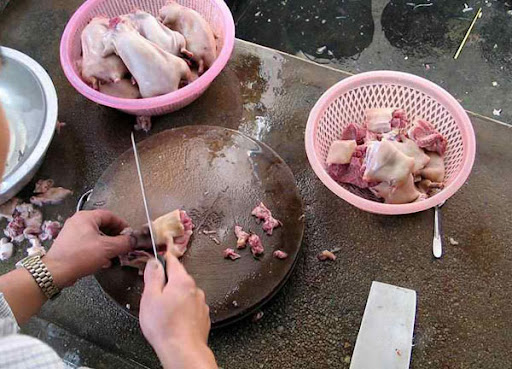
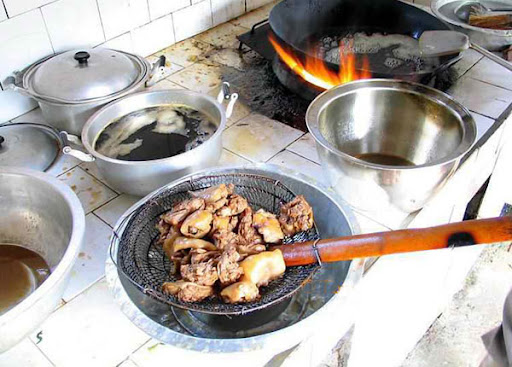
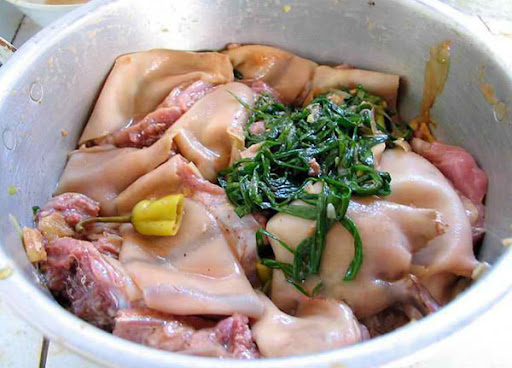
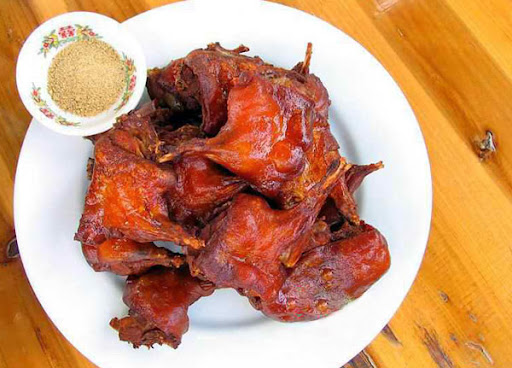
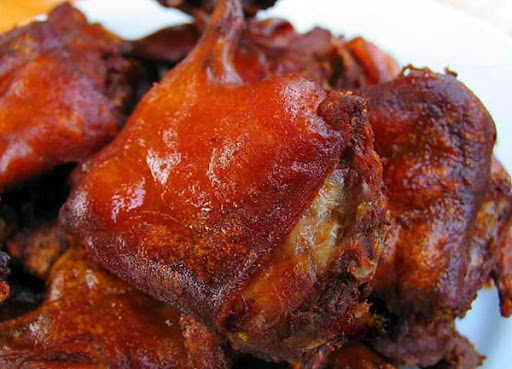
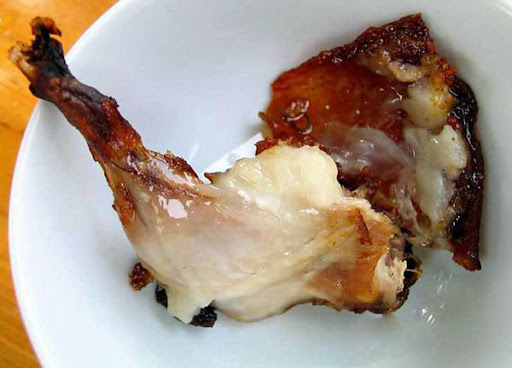
Origins: We don't know the specific origins of the pictures displayed above, but they probably are real images of rats being prepared for human consumption somewhere in Asia. However, it's rather unlikely, as the text accompanying the photos implies, that the rats pictured are vermin rounded up off the street and foisted uponunsuspecting diners as chicken.
The level of preparation and presentation pictured here is indicative of a restaurant (or perhaps a private home) in a part of China where clean, fresh, farm-captured rats are lavishly prepared and served to diners eager to consume rat-meat dishes. Indeed, in some parts of China rat meat sells for considerably more than chicken, pork, or beef.
In 2000, New Yorker reporter Peter Hessler journeyed to Luogang, a small village in China's Guangdong Province specifically because he'd heard Luogang was home to "a famous restaurant that specialized in the preparation of rats." Upon his arrival, he discovered there were two such restaurants (the Highest Ranking Wild Flavor Restaurant and the New Eight Sceneries Wild Flavor Food City) in the village, with a third under construction. Here are a few excerpts from his article, describing what he found out about the preparation and consumption of rats at those restaurants:
Besides rat, a customer at the Highest Ranking Wild Flavor Restaurant can order turtledove, fox, cat, python, and an assortment of strange-looking local animals whose names do not translate into English. All of them are kept live in pens at the back of the restaurant and are killed only when a customer orders one of them.
Many people come from faraway places. They come from Guangzhou, Shenzhen, Hong Kong, Macao. One customer came all the way from America with her son. They were visiting relatives in Luogang, and the family brought them here to eat. She said you couldn't find this kind of food in America.
At the Highest Ranking Wild Flavor Restaurant, I began with a dish called Simmered Mountain Rat with Black Beans. There were plenty of other options on the menu— among them, Mountain Rat Soup, Steamed Mountain Rat, Simmered Mountain Rat, Roasted Mountain Rat, Mountain Rat Curry, and Spicy and Salty Mountain Rat — but the waitress had enthusiastically recommended the Simmered Mountain Rat with Black Beans, which arrived in a clay pot.
I ate the beans first. They tasted fine. I poked at the rat meat. It was clearly well done, and it was attractively garnished with onions, leeks, and ginger. Nestled in a light sauce were skinny rat thighs, short strips of rat flank, and delicate, toylike rat ribs.
"We're not eating city rats," [the restaurant's owner told me]. "The mountain rats are clean, because they aren't eating anything dirty. Mostly, they eat fruit— oranges, plums, jackfruit. People from the government hygiene department have been here to examine the rats. They took them to the laboratory and checked them out thoroughly to see if they had any diseases, and they found nothing. Not even the slightest problem."
I watched dozens of peasants come down from the hills, looking to get a piece of the rat business. They came on mopeds, on bicycles, and on foot. All of them carried burlap sacks of squirming rats that had been trapped on their farms. In Luogang, rats are more expensive than pork or chicken. A pound of rat costs nearly twice as much as a pound of beef.
Last updated: 15 October 2006
Many people come from faraway places. They come from Guangzhou, Shenzhen, Hong Kong, Macao. One customer came all the way from America with her son. They were visiting relatives in Luogang, and the family brought them here to eat. She said you couldn't find this kind of food in America.
At the Highest Ranking Wild Flavor Restaurant, I began with a dish called Simmered Mountain Rat with Black Beans. There were plenty of other options on the menu
I ate the beans first. They tasted fine. I poked at the rat meat. It was clearly well done, and it was attractively garnished with onions, leeks, and ginger. Nestled in a light sauce were skinny rat thighs, short strips of rat flank, and delicate, toylike rat ribs.
"We're not eating city rats," [the restaurant's owner told me]. "The mountain rats are clean, because they aren't eating anything dirty. Mostly, they eat fruit
I watched dozens of peasants come down from the hills, looking to get a piece of the rat business. They came on mopeds, on bicycles, and on foot. All of them carried burlap sacks of squirming rats that had been trapped on their farms. In Luogang, rats are more expensive than pork or chicken. A pound of rat costs nearly twice as much as a pound of beef.
Friday, October 13, 2006
Sewer Ghost
Claim: Ghost of teen who died in a sewer strikes down those who don't repost her story on Myspace.
Examples: [Collected on the Internet, 2006]
Origins: In October 2006, the spooky story about a teen killed by a fall into a sewer after five other girls shoved her began circulating ine-mail and on MySpace.
No adolescent girl named Carmen Winstead or Jessica Smith died in such fashion, in Indiana, or in any other U.S. state "about six years ago." We searched for news reports about such a death and found none. This is a fiction, a typical chain letter of the sort favored bypre-teens. Its key difference lies in its recommended mode of transmission: rather than imploring recipients to mail (or e-mail) it to others, it requires them to post it on their MySpace pages.
As is common with "luck generation" or "ill luck avoidance" chain letters, a specific dire outcome is promised those who do not speed the tale on its way (the ghost of the murdered girl will seek them out and kill them), with proof of the danger being flirted with provided via the included news about the sorry fate that befell someone who failed to heed those instructions (his dead body discovered in the sewer, "his neck broke and his face skin peeled off"). We discuss two other examples of this type of chain letter: one ("Bed Reckoning") uses a seemingly spooky photo; the other ("Skinned Flick") builds upon a fictitious Instant Message exchange.
Barbara "chain of fools" Mikkelson
Last updated: 13 October 2006
Examples: [Collected on the Internet, 2006]
| She was pushed About 6 years ago in Indiana, Carmen Winstead was pushed down a sewer opening by FACT: 2 months ago, 16 year old David Gregory read this post and didn't repost it. When he went to take a shower he heard laughter from his shower, he started freaking out and ran to his computer to repost it, He said goodnight to his mom and went to sleep, If you don't repost this saying "She was pushed" or "They Pushed her down a sewer" Then Carmen will get you, either from a sewer, the toilet, the shower, or when you go to sleep you'll wake up in the sewer, in the dark, then Carmen will come and kill you. About 6 years ago in Indiana, Jessica Smith was pushed down a sewer opening by FACT: 2 months ago, 16 year old Ron Anderson read this post and didn't repost it. When he went to take a shower he heard laughter from his shower, he started freaking out and ran to his computer to repost it, He said goodnight to his mom and went to sleep, If you don't repost this saying "She was pushed" or "They Pushed her down a sewer" Then Jessica will get you, either from a sewer, the toilet, the shower, or when you go to sleep you'll wake up in the sewer, in the dark, then Jessica will come and kill you. |
Origins: In October 2006, the spooky story about a teen killed by a fall into a sewer after five other girls shoved her began circulating in
No adolescent girl named Carmen Winstead or Jessica Smith died in such fashion, in Indiana, or in any other U.S. state "about six years ago." We searched for news reports about such a death and found none. This is a fiction, a typical chain letter of the sort favored by
As is common with "luck generation" or "ill luck avoidance" chain letters, a specific dire outcome is promised those who do not speed the tale on its way (the ghost of the murdered girl will seek them out and kill them), with proof of the danger being flirted with provided via the included news about the sorry fate that befell someone who failed to heed those instructions (his dead body discovered in the sewer, "his neck broke and his face skin peeled off"). We discuss two other examples of this type of chain letter: one ("Bed Reckoning") uses a seemingly spooky photo; the other ("Skinned Flick") builds upon a fictitious Instant Message exchange.
Barbara "chain of fools" Mikkelson
Last updated: 13 October 2006
Tuesday, October 10, 2006
Google Decides YouTube Is Worth $1.65 Billion In Play Money Plus Any Additional Legal Hassles
from the they-did-it dept
After a lot of rumors over the past few days, Google and YouTube made it official, as the online-video site has sold out for $1.65 billion in Google stock. The sale represents the successful execution of the Skype strategy of using the media to seed the idea that the company was worth so much. Seeing as Google spends so much already on its infrastructure and bandwidth, this should put to rest any discussion of how much it costs YouTube to host all those videos. The next worry, of course, is making nice with the content owners, something that the company been pursuing actively. Just today, the site signed deals with Universal, CBS, and Sony BMG. The challenge is not just to get the entertainment companies on board, but to do it in such a way that allows YouTube to remain cool; this was what Napster failed to do when it went legit. Obviously, $1.65 billion is a high price to pay for a young company with an uncertain outlook, but it's known that Google sees big things for online video, and so far hasn't had much success in the space. There's bound to be a lot of pundits giving their thumbs up or thumbs down to the deal. One of the most outspoken on YouTube is Mark Cuban, who of course has a lot of experience with billion-dollar buyouts of video companies. He said this weekend that this deal would be beyond moronic, and that Google can expect scads of lawsuits, not necessarily from big content companies, but from small copyright owners looking for somebody to sue. Now we get our chance to see if he's correct.
Friday, October 06, 2006
Who Needs The Truth When We Can All Just Point At Each Other?
from the well-they-said-it dept
The big story across the web today is that Google is in talks to buy YouTube for $1.6 billion. Of course, there's been no real confirmation that the talks are actually occuring, or that Google's even interested in buying YouTube, but why should that matter? This story has unfolded in a rather curious way. It began with a reasonable post on the Techcrunch blog, titled "Completely Unsubstantiated Google/YouTube Rumor" -- which is fair enough, since it was pretty clear that this was nothing more than an unconfirmed rumor, and the author said he thought it was "40% likely to be at least partially true." There's no real problem, until that post turns into "Google Is in Talks to Buy YouTube" in the Wall Street Journal, with the only sources cited as the ever-present "person familiar with the matter" and the original blog post. But, if it's in the WSJ, it must be true, right? It's good enough for plenty of other big-name outlets to report the story as fact. Then, to complete the circle-jerk of manufactured legitimacy, a different writer on Techcrunch than the original poster says the rumor must be more than 40% true, since, after all, the WSJ reported it. Color us -- and other observers -- skeptical. The "person familiar with the matter" -- who could be anybody that read the original blog post -- the WSJ cited is probably the same person that told the same reporter last month that Yahoo was ready to drop $1 billion on Facebook, a deal we're still waiting on. All this ridiculousness is just the latest step in YouTube's implementation of the Skype billion-dollar buyout plan, which they've used before to drive their price into the billions of dollars and deflect attention away from the question of just how they plan to turn traffic into profits. So just getting one of your VCs to make up an inflated sale price is so old hat; now the plan calls for getting well-read blogs to publish unsubstantiated rumors (even if they're labeled as such), then let the mainstream financial press give the story legitimacy by association, and voila -- your company's now worth another billion. Not a bad morning's work, really, and much easier than actually developing a real business model. For all we know, it's all true. Google could be buying YouTube -- after all, when you use $400 shares of stock for toilet paper, what's $1.6 billion? But the evidence still seems a bit flimsy and we'd rather the discussion about the acquisition happen, you know, after the acquisition.
Wednesday, September 20, 2006
Rioters, police clash again on Budapest streets
By David Chance
TEAR GAS AND WATER CANNON
BUDAPEST (Reuters) - Hungarian Prime Minister Ferenc Gyurcsany on Wednesday blamed opposition parties for a second night of clashes between rioters and police, saying they had failed to deliver on a pledge to calm protests.
The violence was sparked by the prime minister's admission in a tape leaked to media on Sunday of lying to win an election.
Police said 60 people were injured and nearly 100 people were arrested in a second night of turmoil. The demonstration was less serious than the previous evening's riots when more than 150 people were hurt.
More demonstrations, which have spread across the country, are likely for the evening, and tensions could ratchet up further with a planned big demonstration by students on Thursday, and a rightist opposition gathering on Saturday.
"There is order in Budapest and the country, the police have mobilized large forces and defended the city and its people," Gyurcsany said at the beginning of a cabinet meeting.
"I am afraid that those political parties which could have stopped this and called the people back ... failed to take the steps which we had discussed in parliament.
"Radicals are using peaceful demonstrations to cover crime."
The protests were triggered by the leak of a tape on Sunday in which Gyurcsany said he and his party lied repeatedly to win a general election, and that they "did nothing for four years."
Gyurcsany, a 45-year-old millionaire, has vowed to stay on in the face of his biggest crisis during two years in power, and continue with his tough and unpopular budget reforms.
The turmoil, the worst since the fall of communism in 1989, has slightly weakened the forint currency and equity markets also opened softer on Wednesday.
Tensions boiled over in the early hours of Wednesday as riot police, some on horseback, made several runs at small groups of protesters who had broken away from the main demonstration and sporadically threw cobblestones, attempted to set up barricades, broke store windows and set fire to a police car.TEAR GAS AND WATER CANNON
Police responded with tear gas and water cannon. Most of the crowd had left without trouble before the clash and by Wednesday mid-morning there were no protesters on the streets.
Young, successful and energetic, Gyurcsany was seen as a modernizer equipped to lead the EU country to greater prosperity, but the leaked tape has badly damaged his credibility in the eyes of many Hungarians.
In a poll by the Szonda-Ipsos agency after Monday's violence, 80 percent said the riots were unacceptable but 39 percent also blamed the government for the trouble.
The popularity of Gyurcsany's Socialists has slumped to 25 percent from 40 percent in April's election and they face a major test in local elections on Oct 1.
And the question remains as to whether Hungarians feel comfortable with a leader who said: "We lied in the morning, we lied in the evening."
"We have to get rid of them," said Dezso Farkas, a 64-year- old entrepreneur who attended the protests.
Gyurcsany also has to continue to convince members of his own party that he is a credible leader. So far he has received ringing public endorsements from top Socialists.
But he is demanding the party abandon the spendthrift ways which caused Hungary's budget deficit to surge to 10.1 percent of gross domestic product this year, the fifth year of overshoots under a Socialist-led administration.
That is the highest level in the European Union and far from the 3 percent of GDP needed for the euro to which Hungary aspires, which means the country has the highest interest rates in the EU to fend off the ever-present risk of a market crisis.
"We expect fiscal tightening plans for 2007 to remain intact as all the revenue-side measures have already been passed into law," said Nora Szentivanyi, an analyst at JP Morgan.
-- with additional reporting from Balazs KoranyiFriday, September 15, 2006
Woman falls onto MRT tracks; man held
By K.C. Vijayan
Sep 15, 2006
The Straits Times
A WOMAN escaped with minor injuries yesterday after being allegedly pushed off a platform and onto the tracks at Clementi MRT station.
Shouting as she fell, the woman quickly pulled herself up and managed to reach the far side just as a train pulled into the station at 7pm.
The alarm was raised and SMRT staff helped her back onto the platform.
Moments before the incident, a commuter overheard the 26-year-old woman telling a male companion in Mandarin: 'Don't push me.'
Another commuter standing nearby chased the suspect as he began to move away from the scene.
Others rushed to help and held down the suspect, also 26, until police arrived.
He was arrested, and investigations are under way, said police spokesman Mohd Razif.
Train services were disrupted for about 10 minutes, said an SMRT spokesman.
The woman, believed to be in shock, was taken to the National University Hospital.
She suffered bruises to her left forearm and complained of numbness in her right leg.
Commuter Geraldine Ong, 28, who was waiting for the same train as the couple, said: 'I was horrified when I saw her on the tracks.
'The couple may have been fooling around, but this is very dangerous.'
Sep 15, 2006
The Straits Times
A WOMAN escaped with minor injuries yesterday after being allegedly pushed off a platform and onto the tracks at Clementi MRT station.
Shouting as she fell, the woman quickly pulled herself up and managed to reach the far side just as a train pulled into the station at 7pm.
The alarm was raised and SMRT staff helped her back onto the platform.
Moments before the incident, a commuter overheard the 26-year-old woman telling a male companion in Mandarin: 'Don't push me.'
Another commuter standing nearby chased the suspect as he began to move away from the scene.
Others rushed to help and held down the suspect, also 26, until police arrived.
He was arrested, and investigations are under way, said police spokesman Mohd Razif.
Train services were disrupted for about 10 minutes, said an SMRT spokesman.
The woman, believed to be in shock, was taken to the National University Hospital.
She suffered bruises to her left forearm and complained of numbness in her right leg.
Commuter Geraldine Ong, 28, who was waiting for the same train as the couple, said: 'I was horrified when I saw her on the tracks.
'The couple may have been fooling around, but this is very dangerous.'
Thursday, September 14, 2006
Fashion Week Basks in Success of Dress
The dress emerges as a strong trend for spring 2007 at designer previews at N.Y. Fashion week
NEW YORK, Sep. 14, 2006
By SAMANTHA CRITCHELL AP Fashion Writer
(AP) New York Fashion Week is basking in the success of the dress. It's already been a strong item for fall fashion, but it has emerged as the key piece for spring.
Tom Julian, director of trends for McCann-Erickson, said spring 2007 is taking its cue from a classic Audrey Hepburn look _ with A-line shapes and minimal luxe fabrics _ but adding a bit of a "Paris Hilton personality" with strapless tops and other sexy accents.
Shoppers will have their pick of dress silhouettes, since so many versions have been offered, including shifts, sacks, wraps, sundresses and halters.
Other things that have caught Julian's eye are trench and trapeze coats, blouses, walking shorts, miniskirts and even bold distinctive accessories.
"The checklist? The chemise, the cropped boxy jacket, the bell skirt, the angel sleeve blouse, an eyelet something," he said Wednesday.
_ Anna Sui: Sui took her audience to a bizarre "Alice in Wonderland" tea party that was crashed by some punk pirates.
Sounds about right for Sui, who relishes in her role as fashion's rebellious rocker chick, and her clothes reflected that. Many of the outfits were still wearable, even the unlikely pairing of a pretty black embroidered organza dress with a ripped mesh top.
A navy chiffon and gauze halter dress with a navy and cream striped knit T-shirt, a bold red floral print dress with a matching coat, and a drop-waist, lace-up, short-sleeve dress in the "multi tea party" print were among the looks that would look cute on Sui's sassy, stylish fans.
A red floral scarf-print drawstring dress also was adorable from the front, but the back was missing, exposing the model's floral bikini bottom. Guess that was the point.
_ Michael Kors: So many little girls dream of being a dancer. After Kors' show, many big girls will dream of wearing dancer-inspired clothing.
To a soundtrack laced with music from the Broadway show "A Chorus Line," models went down the runway in full, fluid jersey skirts _ the best ones, called "rehearsal skirts," were asymmetrical with a high slit on one side _ and soft cashmere sweaters.
A tan silk georgette pleated dress with a black cardigan and black leggings would be the go-to outfit in any woman's closet because it was sexy, sweet and modest _ and looked incredibly comfortable.
Other must-have looks were a cashmere sweater that slid down one shoulder worn with one of those tan rehearsal skirts, a feminine nude-colored silk chiffon skirt that practically floated, a jersey halter dress with a scarf that trailed behind, and a nude-colored eyelet trench coat.
Sticking to the theme, Kors offered light pink tap shorts but he balanced them with a long, slouchy blazer.
For the closet disco dancer, he showed a loose minidress covered in shimmering black paillettes and a white wrap shirt with a black paillette legging. Both outfits were full of pizazz.
A kimono-style shift in nude paillettes was a little more subtle, but just as seductive.
_ Matthew Williamson: Anyone waiting for a blast of bright colors got it at Williamson's show, held inside a newly renovated building at a Hudson River pier.
An entire group of outfits seemed to be inspired by button candy _ sweet little circles in all the shades of the rainbow.
Another section featured Southwest-style embroidery; the standout piece was a beaded dress in an airy apricot-colored fabric. There also were florals and a metallic lily pad print. Just go with it _ this is the wild Williamson we're talking about.
_ Carmen Marc Valvo: Valvo is known for eveningwear, and there were indeed many lovely cocktail dresses and gowns at his show, but it was the swimwear that really stood out.
His "full-bodied bikini" looked more like a dainty, black-lace, long-sleeve bodysuit _ but it also looked great.
Another noteworthy swimsuit was a gold wrap-front maillot with a plunging V in the front and an even lower one in the back. There also was a pretty black floral-lace beach cover-up.
A dress worth singling out was a very Old Hollywood gown in a silver hammered satin with a draped back.
_ Peter Som: With this collection, Som courted sophisticated and refined women who also want to wear the looser shapes of the season.
A feminine organdy blouse with full angel sleeves was heavenly as was a white organdy strapless dress with tiny pleats.
His coats, including a 3/4-length cocktail coat in a dove gray lace-jacquard fabric, were among the best items.
_ Ports 1961: Ports 1961, a brand that originated in Canada, made its first appearance at New York Fashion Week with a collection rooted in 1940s Argentina.
Somehow on the catwalk, though, it all made sense.
Many of the dresses were delicate and romantic, especially a gold pleated-front strapless dress with a tiny lace jacket and a light-as-a-feather capelet halter dress with an open back that was done in an airy cream-colored fabric.
There were some fiery dresses, too _ remember the Argentinian connection? A red halter dress with a fitted top and flounced bottom would be perfect for dancing.
NEW YORK, Sep. 14, 2006
By SAMANTHA CRITCHELL AP Fashion Writer
 (AP) (AP) |
Tom Julian, director of trends for McCann-Erickson, said spring 2007 is taking its cue from a classic Audrey Hepburn look _ with A-line shapes and minimal luxe fabrics _ but adding a bit of a "Paris Hilton personality" with strapless tops and other sexy accents.
Shoppers will have their pick of dress silhouettes, since so many versions have been offered, including shifts, sacks, wraps, sundresses and halters.
Other things that have caught Julian's eye are trench and trapeze coats, blouses, walking shorts, miniskirts and even bold distinctive accessories.
"The checklist? The chemise, the cropped boxy jacket, the bell skirt, the angel sleeve blouse, an eyelet something," he said Wednesday.
_ Anna Sui: Sui took her audience to a bizarre "Alice in Wonderland" tea party that was crashed by some punk pirates.
Sounds about right for Sui, who relishes in her role as fashion's rebellious rocker chick, and her clothes reflected that. Many of the outfits were still wearable, even the unlikely pairing of a pretty black embroidered organza dress with a ripped mesh top.
A navy chiffon and gauze halter dress with a navy and cream striped knit T-shirt, a bold red floral print dress with a matching coat, and a drop-waist, lace-up, short-sleeve dress in the "multi tea party" print were among the looks that would look cute on Sui's sassy, stylish fans.
A red floral scarf-print drawstring dress also was adorable from the front, but the back was missing, exposing the model's floral bikini bottom. Guess that was the point.
_ Michael Kors: So many little girls dream of being a dancer. After Kors' show, many big girls will dream of wearing dancer-inspired clothing.
To a soundtrack laced with music from the Broadway show "A Chorus Line," models went down the runway in full, fluid jersey skirts _ the best ones, called "rehearsal skirts," were asymmetrical with a high slit on one side _ and soft cashmere sweaters.
A tan silk georgette pleated dress with a black cardigan and black leggings would be the go-to outfit in any woman's closet because it was sexy, sweet and modest _ and looked incredibly comfortable.
Other must-have looks were a cashmere sweater that slid down one shoulder worn with one of those tan rehearsal skirts, a feminine nude-colored silk chiffon skirt that practically floated, a jersey halter dress with a scarf that trailed behind, and a nude-colored eyelet trench coat.
Sticking to the theme, Kors offered light pink tap shorts but he balanced them with a long, slouchy blazer.
For the closet disco dancer, he showed a loose minidress covered in shimmering black paillettes and a white wrap shirt with a black paillette legging. Both outfits were full of pizazz.
A kimono-style shift in nude paillettes was a little more subtle, but just as seductive.
_ Matthew Williamson: Anyone waiting for a blast of bright colors got it at Williamson's show, held inside a newly renovated building at a Hudson River pier.
An entire group of outfits seemed to be inspired by button candy _ sweet little circles in all the shades of the rainbow.
Another section featured Southwest-style embroidery; the standout piece was a beaded dress in an airy apricot-colored fabric. There also were florals and a metallic lily pad print. Just go with it _ this is the wild Williamson we're talking about.
_ Carmen Marc Valvo: Valvo is known for eveningwear, and there were indeed many lovely cocktail dresses and gowns at his show, but it was the swimwear that really stood out.
His "full-bodied bikini" looked more like a dainty, black-lace, long-sleeve bodysuit _ but it also looked great.
Another noteworthy swimsuit was a gold wrap-front maillot with a plunging V in the front and an even lower one in the back. There also was a pretty black floral-lace beach cover-up.
A dress worth singling out was a very Old Hollywood gown in a silver hammered satin with a draped back.
_ Peter Som: With this collection, Som courted sophisticated and refined women who also want to wear the looser shapes of the season.
A feminine organdy blouse with full angel sleeves was heavenly as was a white organdy strapless dress with tiny pleats.
His coats, including a 3/4-length cocktail coat in a dove gray lace-jacquard fabric, were among the best items.
_ Ports 1961: Ports 1961, a brand that originated in Canada, made its first appearance at New York Fashion Week with a collection rooted in 1940s Argentina.
Somehow on the catwalk, though, it all made sense.
Many of the dresses were delicate and romantic, especially a gold pleated-front strapless dress with a tiny lace jacket and a light-as-a-feather capelet halter dress with an open back that was done in an airy cream-colored fabric.
There were some fiery dresses, too _ remember the Argentinian connection? A red halter dress with a fitted top and flounced bottom would be perfect for dancing.
Spanish fashion show bans underweight models
Last Updated Wed, 13 Sep 2006 11:38:02 EDT CBC News
Organizers of a top fashion show in Spain say they will reject overly thin models who protesters say encourage eating disorders in girls.
The Association of Fashion Designers of Spain said it wanted to project "an image of beauty and health" for the Madrid show, which runs Sept. 18-22, rather than rail-thin looks.
Medical associations and women's advocacy groups protested last year's show, saying some models were too thin.
The show is using the body mass index or BMI, a calculation of weight in relation to height, to measure the models. About 30 per cent of would-be participants at a previous event failed the test.
World Health Organization experts recommend a BMI of between 18.5 and 25. The show has hired medics to check models. Models with a BMI of less than 18 will be turned down.
The fashion industry has a responsibility to portray healthy body images, including fuller-figured women, said Madrid's regional government, which sponsors the show.
Role models for young girls
Fashion shows "are mirrors for many young women," and the women who stroll down the catwalk are role models for young girls obsessed with thinness, said Concha Guerra, deputy finance minister of the regional administration.
This is the first time extremely thin models have been excluded from a major international fashion show, said Jesus del Pozo, a designer who is part of the Spanish association running the show.
The fashion industry is being used as a scapegoat for eating disorders, responded Cathy Gould of New York's Elite modelling agency.
"I think it's outrageous," Gould told Reuters. "I understand they want to set this tone of healthy, beautiful women, but what about discrimination against the model and what about the freedom of the designer?"
The focus should be on designers' collections, not model size, a spokeswoman for the Spanish fashion designers association said.
So far, other major international fashion shows have not followed the Spanish example.
With files from The Associated Press.
Tuesday, September 12, 2006
Bloggers, don't forget to back up
Accidents or hackers can destroy hours of hard work, so learn to save your journal for posterity
YOU HAVE spent hours, and written volumes on your blog.
YOU HAVE spent hours, and written volumes on your blog.
Then, one day the worst thing imaginable happens - your online diary crashes.
The good news is, that does not need to happen.
Just as you take care to back up your photos, work and other important documents, you can and should do the same with blogs.
Like other electronic information, you cannot assume that your journal is completely safe and will remain intact indefinitely.
Blogs or web-hosting providers may come and go. Hard disks on servers may fail. Malicious hackers might delete all your words and photos at will.
On a more practical level, you might decide to migrate to another provider or blogging platform. Having a backup can make the transition smoother.
Ultimately, having a backup simply means your journal has a higher chance at posterity.
Here are some tips to help you accomplish this.
Read the documentation
There is no one single method to back up a blog, since there are literally hundreds of blogging platforms and providers out there.
Read the documentation of your blogging software or the help section of your blog provider.
If they already provide the instructions to backup your blog, it is fairly safe to follow them.
DIY
If you are hosting your own server and blog, check with your service providers to see if they generate automatic backups.
Even if they do, it would be prudent to generate your own backups and download them to your computer.
For instance, if your server has a Cpanel control panel, you might be able to select 'Backup' then 'Full Backups'.
Your hosting provider should be able to regenerate your site and blog from these backups.
Do not panic if you cannot find any documentation or backup features.
You can still get around such obstacles - just roll up your sleeves and do the backup manually.
Just as you can save a web page for future offline browsing, you can save your blog pages too.
But do not do it the slow way, opening each blog page and then saving them.
Get a tool such as HTTrack, which allows you to save whole websites for offline browsing. These tools can automatically 'crawl' your blog, saving and preserving the pages and link structure.
Two birds with one stone
Tired of service and site interruptions on your free blog provider?
Get an offline blogging tool instead. These will allow you to compose your journals on the computer without the need to log into your blog.
The good thing is that you can easily save a copy of your completed entry to your computer, then upload the entry to your blog.
Certain tools such as w.bloggar also allow you to post to multiple blogs simultaneously, which in its way is a form of backing up as well.
Help! I seem to have lost everything!
If you don't already have a backup, and neither does your service providers, your last hope would lie in the caches on the web.
How this works is that Google takes a snapshot of webpages as it crawls the web.
If your blog has been cached into Google's servers, you could then retrieve the snapshot by following the link labelled 'Cached' that appears beside the search result for your blog.
Try googling for your own blog, and then follow Google's cached pages.
IDA Technology Showcase for IMF/WB Delegates
They get first-hand look at emerging infocomm technologies for the financial sector.
Delegates in Singapore for the IMF-World Bank meetings will catch a glimpse of the future workplace in the financial industry here.
They will have a tantalising first-hand look at how emerging infocomm technologies will change the office and home environment, and enhance the working processes in the financial sector.
To promote and demonstrate the nation's strong technological infrastructure and focus, the Infocomm Development Authority (IDA) will unveil the Government Executives in the New Information and Knowledge Era" (Genie) showcase to the IMF and World Bank delegates.
Head of Civil Service, Mr Peter Ho said: "Infocomm will continue to be a key enabler for all sectors of the economy, including the public sector. The Genie showcase represents how infocomm can be exploited to transform the way public officers work, and to create solutions that will enhance operational efficiency and productivity for the public sector."
On display at the showcase are prototype technologies aimed at the public sector, and which would be made commercially available in three to five years. Although tagged for future development, such efforts reflect the myriad of digital possibilities that would revolutionise the workplace in years to come.
In August this year, IDA announced its dedicated investment in a "technology-enabled work environment". Challenging Singaporeans to imagine a nation in 2010 where civil servants thrive within integrated communications and sophisticated systems that are a staple of the workplace, IDA went on to sketch out plans to realise these possibilities.
And thus was conceived Genie. Launched last month, it marked the first time three major multi-national corporations - Microsoft, Intel and Fujitsu - came together with the government to put together a showcase, utilising technologies in research and development.
Mr Leong Keng Thai, Deputy Chief Executive and Director-General of Telcoms, says: "This further attests Singapore's position as a leader in infocomm technology exploitation and a global infocomm hub."
Some key highlights of the showcase are provided below:
HIGHLIGHTS OF KEY TECHNOLOGIES IN THE GENIE SHOWCASE
Technology to better manage infocomm security
• “Contact-Less” Palm-Vein Biometrics Security System checks the unique pattern of a person’s blood veins in the palm to establish identity to gain access to the office premises and desktop.
• Information Rights Management ensures documents circulated are kept confidential.
• Active Management Technology allows IT departments to better discover, diagnose and protect networked computing assets remotely even those that are unregistered or turned off.
• Virtualisation Technology allows the IT department of an organisation to perform security patches, and/or update virus definitions without interrupting the user.
• Steganography technology embeds digital information within an image, and the information will only be revealed upon authentication.
Technology to enhance productivity cum efficiency of government executives
• Microsoft Intelligent Integrated Dashboard and Universal Unified Communications Panel simplify the productivity, collaboration and knowledge sharing capabilities of users. One universal integrated interface enables access to all information such as emails, live key performance indicators data feed, project documents, calendar and notes.
• Tight integration between Operating System, Office Productivity Suite and Collaboration Tools to improve productivity and efficiency.
• Predictive Collaboration Workspace automatically generates documents and templates relating to specific tasks or projects. For example, when a workspace is generated for a budgeting exercise, the workspace automatically extracts relevant information, forms, templates, subject matter experts, policies and guidelines.
• Cross Media Retrieval Solution searches for information on the internet or within an organisation using search keys in the form of text, image or video.
Technology to enhance the mobility of government executives
• Intelligent Communications application is integrated with the user's calendar, and messages are routed to the user accordingly. For example, if the user is not at his desk, an email arriving at the desktop will be converted to a voicemail and forwarded to the user's mobile phone.
• Colour Electronic Paper stores and displays digital information such as documents and current news. It is handy and you can use it anywhere and anytime.
IMF: Risks of global economic slowdown increased
SINGAPORE (AP) -- The International Monetary Fund warned Tuesday that the risks of a global slowdown have increased due to higher interest rates, surging oil prices and an apparent cooling in the U.S. housing market that could slow the U.S. economy.
While the IMF said its general outlook on the global economy remains positive, "there are risks to the global economic outlook that have tilted to the downside," according to its semiannual Global Financial Stability Report.
Should global growth falter, the IMF said international financial markets could undergo a more severe correction than the one they experienced in May and June, when emerging markets in particular were hit hard.
"The recent market turbulence is a timely reminder for authorities to strengthen macro-economic policies and persevere with needed structural reforms," said the report, released a week before the Washington-based institution holds its Sept. 19-20 annual meeting in Singapore.
In its latest assessment of the global financial system, the IMF also warned that the risk of a disorderly decline in the U.S. dollar could increase unless policies are put in place to address global saving and investment imbalances.
"The potential for a disorderly unwinding of global imbalances remains a concern," the IMF said.
The IMF said emerging Asian countries should be more ambitious in increasing exchange-rate flexibility, the U.S. should consolidate its fiscal position and Europe and Japan should speed up structural changes.
It noted that foreign holdings of U.S. assets continue to grow, rising to US$6.3 trillion by June 2005 from US$1.2 trillion in 1994.
The report also said that demand for U.S. assets will increasingly depend on Asian central banks, which currently hold more than half the world's foreign currency reserves, and oil-producing nations, which have amassed substantial reserves in the last two years or so.
"There may be some shift in demand away from the highly liquid, short-duration, fixed-income assets typically held in official reserves portfolios," which could result in a disorderly decline in the U.S. dollar unless policy-makers take appropriate action, it said.
Group of Seven finance ministers and central bankers plan to meet Saturday in Singapore, ahead of the IMF and World Bank annual meetings, to discuss exchange rates and other topics.
Market consensus is for Asian currencies to appreciate over the medium-term while non-Asian currencies are expected to weaken, and the dollar is expected to remain relatively stable, the IMF said.
Tuesday's report gave a general indication of the IMF's outlook on the global economy two days before it releases the second part of its closely watched World Economic Outlook, which includes specific economic forecasts for the world economy and regional economies.
Despite its warnings, the IMF said it sees "a continuation of favorable developments, in both growth and inflation. Under this scenario, corporate earnings growth would remain healthy and default rates low."
The volatility in financial markets in May and June -- sparked by worries about higher global interest rates -- was "modest" and "not a harbinger of a protracted downturn," it said.
Global markets have performed strongly in recent years, resilient to several market corrections, it said. At the same time, global growth remained strong.
"Corporate fundamentals are also still solid," the IMF said. "Most companies are still expecting respectable growth in earnings over the next year or so, even after very strong growth in recent years."
However, risks remain, including inflationary pressures, particularly given soaring oil prices. It also said a rapid cooling-off in the U.S. housing market could lead to a pronounced slowdown of the U.S. economy.
"International financial markets could undergo more severe corrections, especially because markets appear to be pricing in the baseline growth scenario with little provision for risk," it said.
Thursday, September 07, 2006
Teen gets high fever and dies 3 days later
Doctors, parents don't know what killed the Sec 3 student
SECONDARY 3 student Yew Zhi Hao had never been seriously ill.
SECONDARY 3 student Yew Zhi Hao had never been seriously ill.
But on Monday, just three days after he came down with a high fever, the gifted student and keen soccer player was dead.
Neither doctors nor his parents know what killed him, said his parents.
In fact, the Raffles Institution boy was fine last Thursday, the day before he became feverish, and had been busy preparing for his examinations two weeks away.
His father Yew Kok Seng, 52, a deputy chief executive of a computer firm, related the sequence of events that led to his only child's death.
When Zhi Hao, 15, suddenly fell ill last Friday, he said, he and his wife took him to a nearby clinic.
'With the medicine, the fever subsided but the next day, he started vomiting and couldn't eat or drink.'
As the first clinic was shut, the parents took him to another one, where he was prescribed more medicine.
But while Zhi Hao's vomiting stopped, his fever returned on Monday morning.
Mr Yew said: 'He was perspiring, and coughing and there was blood in his phlegm.
'We went back to the second doctor and got medicine for his infected throat. But his condition worsened. He was foaming at the mouth and could not breathe properly.
'He told us that he was was losing consciousness and then went into a coma and never woke up.'
The parents later took him back to the doctor, who tried to revive him, and sent him to Changi General Hospital. But Zhi Hao died in hospital at 1.20pm.
About 80 schoolmates and teachers were at his wake at Sin Ming Drive yesterday.
Mrs J. Selvan, who taught Zhi Hao last year, said: 'He was an exemplary student, meticulous in his work, polite and helpful, and did not boast or show off.'
His father said that Zhi Hao was a remarkable pupil even in St Hilda's Primary School, where he was selected for the gifted stream when he was in Primary 4.
Fluent in English and Mandarin, he won the Prime Minister's Book Prize in Primary 6 and was one of the top scorers in the Primary School Leaving Examination.
He then went to Raffles Institution. But he was no bookworm. He had been an avid footballer for more than eight years.
In fact, his father bought him a football several weeks ago after he qualified for the National University of Singapore's tutelage programme for talented students.
'We will cremate him with the ball as he was very into football,' said Mr Yew.
Both father and son are fans of English Premiership side Manchester United.
His parents are trying to cope with their loss.
When Mr Yew saw teachers and schoolmates in tears, he said: 'Please don't cry and don't call out for him to return, for Zhi Hao has lived his life and should go to heaven unhindered.'
Experience in the classroom
ONE OF the myths about teaching is that it's an easy job. After all, don't teachers get long vacations and have short work days? The truth is, teachers put in far longer hours than is readily apparent. There are lesson plans to prepare, exams to grade and extra-curricular activities to supervise. All of that before actual classroom
time is considered. While there is no doubt of the satisfaction to be had from seeing young charges do well, teaching is as challenging a profession as any. It is right, then, that the Government has repeatedly sought fresh ways to reward this dedication. Now, new measures again are being directed at the profession. This time, initiatives are meant to recognise the value of experience and the importance of absorbing fresh ideas from outside the formal professional structure.
Certainly, financial incentives remain key. But it is important to note how they are being structured. Soon, teachers who stay in the profession for 40 years before retirement can expect their gratuities to rise to as much as $160,000. Just as important, the Government is investigating how salaries of mid-career entrants to teaching can be raised more quickly to match those of their new colleagues. Such new teachers - who are likely to take a cut in pay changing careers - bring a wealth of experience in a variety of disciplines that can only help cross-pollinate ideas in the common room. They deserve to be encouraged. Meanwhile, changes to rules on sabbaticals should prompt more teachers to test new grounds for fresh insights to bring into the classroom - and lessen the danger of burnout. Indeed, these three measures alone should go far in both retaining and recruiting deep and broad experience that can only benefit a profession that now includes many young faces. For after much success with conventional recruitment, a third of Singapore's 28,500 school teachers are aged 30 or younger. Like everyone else, young teachers need mentoring, too.
time is considered. While there is no doubt of the satisfaction to be had from seeing young charges do well, teaching is as challenging a profession as any. It is right, then, that the Government has repeatedly sought fresh ways to reward this dedication. Now, new measures again are being directed at the profession. This time, initiatives are meant to recognise the value of experience and the importance of absorbing fresh ideas from outside the formal professional structure.
Certainly, financial incentives remain key. But it is important to note how they are being structured. Soon, teachers who stay in the profession for 40 years before retirement can expect their gratuities to rise to as much as $160,000. Just as important, the Government is investigating how salaries of mid-career entrants to teaching can be raised more quickly to match those of their new colleagues. Such new teachers - who are likely to take a cut in pay changing careers - bring a wealth of experience in a variety of disciplines that can only help cross-pollinate ideas in the common room. They deserve to be encouraged. Meanwhile, changes to rules on sabbaticals should prompt more teachers to test new grounds for fresh insights to bring into the classroom - and lessen the danger of burnout. Indeed, these three measures alone should go far in both retaining and recruiting deep and broad experience that can only benefit a profession that now includes many young faces. For after much success with conventional recruitment, a third of Singapore's 28,500 school teachers are aged 30 or younger. Like everyone else, young teachers need mentoring, too.
Wednesday, September 06, 2006
An heir is born
 |  |
| Japanese rightists march with a congratulatory banner in front of the imperial palace in Tokyo. | Children prepare to fly a carp streamer to celebrate the birth of a boy in the Japanese imperial family in central Tokyo. |
 | |
 |  |
| Japan's Emperor Akihito and Empress Michiko wave to wellwishers during their visit in Sapporo, northern Japan. | Japanese Prince Akishino and his daughters, Princess Mako, left, and Princess Kako arrive at Aiiku hospital in Tokyo, Wednesday, Sept. 6, 2006. |
| |
 |  |
Prince Akishino and his wife Princess Kiko chat | Japan's Empress Michiko wave from a limousine to well-wishers in Sapporo, northern Japan. |
| |
 |  |
| Young Japanese women read an extra reporting the birth of new prince in Tokyo. | Customers shop at a confectionery shop in Tokyo, where a sign to celebrate the birth of Princess Kiko's baby is placed Wednesday, Sept. 6, 2006. |
| |
 | |
| Journalists pack in front of a Tokyo's hospital where Princess Kiko has been hospitalized early Wednesday, Sept. 6, 2006 before the princess gives birth. | |
Wardrobe for the Weightless: Space Inspires Fashion Show
By Leonard David
Senior Space Writer
posted: 09 June 2006
04:45 pm ET


Senior Space Writer
posted: 09 June 2006
04:45 pm ET
Maybe musician Donald Fagen was onto something. In his classic 1982 song, I.G.Y. (What A Beautiful World), the sometime-Steely Dan collaborator sang of adventurers buying a ticket to the wheel in space and a world with spandex jackets for everyone.
Well, while the wheel is still in the drawing stages, the Japanese Aerospace Exploration Agency (JAXA) and Rocketplane Ltd., along with numbers of designers and artisans, have taken it upon themselves to improve on the spandex: a Hyper Space Couture Design Contest.
Runway fashion
The multi-part competition has been underway for several months, patterned to elicit space tourism fashion ideas. A key rule is that suborbital wear submittals must be functional and scientific—but don’t forget a stylish chic.
“Rocketplane made the fundamental design decision to fly in a true ‘shirtsleeve environment’ very early in the development program,” explained Chuck Lauer, Vice President of Business Development for Rocketplane, based in Oklahoma City, Oklahoma.
Rocketplane’s XP vehicle will accommodate a pilot and three passengers. The fighter-sized craft is powered by both turbojet engines and a rocket engine. The vehicle is being built to accelerate to speeds of some 2,386 miles per hour (3,500 feet per second) and reach altitudes in excess of 330,000 feet (100 kilometers). Flying that suborbital profile, all onboard will be weightless for three to four minutes during the trek to the edge of space.
“In our view, not having to wear bulky pressure suits, helmets or breathing masks will enhance the customer’s space flight experience,” Lauer told SPACE.com.
Say no to Nomex
It was Misuzu Onuki, Asia Liaison for the Space Frontier Foundation and Rocketplane's Asian Business Representative, who first identified the need for design, creative expression and personal preference to become a part of the customer’s individual space flight choices.
“We were stuck in the ‘old school’ way of thinking about space flight clothing. We assumed that our choices were limited to picking our own Midnight Blue company color for the standard Nomex military flight suit, with our own logo patches in place of the NASA meatball,” Lauer pointed out.
The Space Couture Design Contest—organized by Ms. Onuki, Eri Matsui, a fashion designer based in Tokyo, and their colleagues in JAXA and the fashion industry—have spurred a fresh and exciting look at what the possibilities for personal space wear really can be.
The contest is zipping forward to having the top 10 finalists produce and test their personal creations, Lauer explained. The winning designs will become part of the catalog of Rocketplane Official Space Wear.
“Ultimately, we would like to see additional design contests for the European and American markets and a whole line of winning space wear fashion designs become a part of our catalog,” Lauer said.
Casual wear for space
The space wear contest is for the first generation of space tourism, Onuki explained.
“So far, space tourism wear has been not so considered … though space tourism is very popular among the general public,” Onuki observed. “However, wear for space tourism is one of the important elements to make space tourism very dramatic and exhilarating.”
Onuki told SPACE.com that she has been engaged in research geared toward casual wear for space over the last five years.
“Though it is easy to ask a famous fashion designer to design space suits, I chose another way to encourage mass market public attention to space tourism by performing the competition,” Onuki added. “To do that, we got a new pleasure. I was sure that it must be interesting to see the design pictures which embody people’s image and dreams towards personally experiencing space flight.”
Catwalk in space
Onuki said that, in working with fashion designer, Ms. Matsui, the intent is to cross-thread mathematics, science, art, and physics with fashion.
To date, there have been several kickoff events, as well as fashion shows to stir interest in the multi-step contest. At the end of March, contest officials had received 882 drawings by 365 individuals. Last month, the top 10 designs plus three alternate designs were picked. The actual winner, second and third place will be selected later this year.
“I think that it will be very hard to select one as the ultimate winner,” Onuki admitted.
Contest organizers plan to perform the first space fashion show—“Catwalk in Space”—this autumn hosted by Space Travellers of Germany, as well as German and Japanese media.
A Zero G Wedding Dress designed by Matsui, as well as the top 10 designers garbed in their own outfits, will float in weightlessness courtesy of a parabolic-flying Russian Ilyushin 76 aircraft.


Boy 14, Wins Cancer fight, but dies after he is hit by car
Singapore- A 14-year-old boy on the road to recovering from cancer died after he was knocked down by a hit-and-run driver while crossing a Singapore street, news reports said Wednesday. Tan Kwang Zhen died in a hospital and was cremated Tuesday, only hours before an interview detailing his battle with the disease cancer was screened on television, The Straits Times reported.
The driver of the car, a 27-year-old man, was arrested after knocking down the secondary school student who was walking with his mother and 7-year-old brother on August 31.
Kwang Zen described his ordeal with the disease in the prerecorded programme.
Diagnosed with leukaemia when he was 12, Kwang Zhen said that he and his mother cried for a "whole day."
"To die at 12 was a bit early," he said. "There's a lot of things I had not done."
At one point, his weight dropped to 28 kilograms, but Kwang Zhen's condition improved after an 18-month struggle.
The cancer went into remission, and he was well enough to return two months ago to school.
Though he started school six months after his classmates, he had a "strong learning ability" and coped well, the newspaper quoted counsellor Soh Shiow Jiuan as saying. He "always carried a smile."
"You can't tell what's going to happen in life. Whatever comes, you have to try to grapple with it," were the youth's last words on the TV programme.
The driver of the car, a 27-year-old man, was arrested after knocking down the secondary school student who was walking with his mother and 7-year-old brother on August 31.
Kwang Zen described his ordeal with the disease in the prerecorded programme.
Diagnosed with leukaemia when he was 12, Kwang Zhen said that he and his mother cried for a "whole day."
"To die at 12 was a bit early," he said. "There's a lot of things I had not done."
At one point, his weight dropped to 28 kilograms, but Kwang Zhen's condition improved after an 18-month struggle.
The cancer went into remission, and he was well enough to return two months ago to school.
Though he started school six months after his classmates, he had a "strong learning ability" and coped well, the newspaper quoted counsellor Soh Shiow Jiuan as saying. He "always carried a smile."
"You can't tell what's going to happen in life. Whatever comes, you have to try to grapple with it," were the youth's last words on the TV programme.
Wednesday, August 16, 2006
RFID-Equipped Passports Come to U.S.
Federal officials said Monday that United States passports equipped with RFID tags would soon begin to make their way to consumers, with its Colorado Passport Agency being the first to produce the documents.
Although the federal government insists the passports are safe, security researchers say the data on the tags can be compromised.
Researchers at the Black Hat conference in Las Vegas earlier this month showed how RFID tags could be read and copied to a smart card, which in turn could be used to make a fake passport. Such issues could pose massive security risks, especially as airport officials are again trying to clamp down on security at international airports.However, the warnings are not stopping the federal government from going ahead with its plans. The rest of the country's passport distributing offices will convert to the new system by October of this year, the State Department said. Federal officials are already carrying the new devices under a test program conducted by the agency.
The State Department said it has taken a "multi-layered approach" to prevent data from falling into the wrong hands. Metallic anti-skimming technology has been included in the front cover and spine of the passport, which it says would not allow the data to be read when the passport is closed.
Other technologies such as Basic Access Control, which requires a key be read to unlock the chip, a randomized unique identification (RUID) to prevent tracking of an e-passport holder, and an electronic signature are all features intended to keep the passport holder's personal data intact.
"The Department of State is confident that the new e-passport, including biometrics and other improvements, will take security and travel facilitation to a new level," it said in a statement.
Moreover, features such as the digital photograph embedded in the data would practically make it impossible for a person to use a passport unless they looked similar to the person, say officials.
Subscribe to:
Posts (Atom)


